By Dr. Ronald Vaught | Functional Medicine | Beyond Health and Wellness, Oak Forest, IL
My Friends, I first wrote this post back in 2017, and I called it an apocalypse. Nine years later, do I need to take that back? Wait for it... wait for it... No. If anything, I undersold it.
Today an estimated 7.4 million Americans age 65 and older are living with Alzheimer's disease. That's about 1 in 9 people in that age group. Barring a medical breakthrough, that number is projected to reach nearly 13 million by 2050. Alzheimer's is now the fifth-leading cause of death among Americans 65 and older, and 1 in 3 seniors dies with Alzheimer's or another dementia.
Now follow the money. Caring for people with dementia will cost an estimated $409 billion this year, and nearly $1 trillion by 2050. Medicare and Medicaid cover about 64% of that bill. Can they sustain that price tag? That doesn't even count the more than 19 billion hours of unpaid care that families gave last year. So this isn't just a health apocalypse. It's an economic one, and it lands squarely on our kids.
Here's the good news, and it's the reason I'm reposting this. In 2024 a major international panel of dementia experts (the Lancet Commission) concluded that nearly half of all dementia cases could be prevented or delayed by addressing 14 risk factors that we can change. Half! That's where we come in.
And here's what the headlines are missing. A growing body of research suggests Alzheimer's may be, at least in part, a disease of an immune system that has turned on its own brain. If that's true, it changes everything about how we should be preventing it.
WHAT'S DRIVING ALZHEIMER'S?
Scientists believe Alzheimer's develops from a mix of genetics, lifestyle and environment acting on the brain over decades. Some researchers have nicknamed it "type 3 diabetes" because the brain in Alzheimer's often shows a kind of insulin resistance, much like the body does in type 2 diabetes. When brain cells can't use fuel properly, you get inflammation, oxidative stress and trouble handling fats. Over many years, that onslaught is linked to the buildup of amyloid plaques and tau tangles, the hallmarks of the disease.
My take hasn't changed: when the problem builds for 20 or 30 years before the first symptom, the solution has to start long before the diagnosis.
IS ALZHEIMER'S AN AUTOIMMUNE DISEASE?
Traditionally, Alzheimer's has been classified as a neurodegenerative disease, not a classic autoimmune disease like rheumatoid arthritis, Hashimoto's or celiac. But the science is moving fast, My Friends, and it's moving in the direction I've been pointing for years.
The "plaque" may be part of your immune system. For decades we've treated amyloid as garbage that clogs the brain. Then in 2016, Harvard researchers showed that amyloid acts like a natural antibiotic, trapping bacteria and other invaders in a sticky net to protect brain cells. In other words, the plaque may be the immune system doing its job.
And then doing it too well. In 2022, Dr. Donald Weaver and his team at Toronto's Krembil Brain Institute proposed a new model in the journal Alzheimer's & Dementia: Alzheimer's as a chronic autoimmune condition. In their model, amyloid is a normal immune messenger that helps the brain fight infection and recover from injury. The problem? It can't tell the difference between an invading bacterium and your own brain cells, because their outer membranes look alike. So the immune response meant to protect the brain ends up attacking it, again and again, for years. Sound familiar? That's the definition of autoimmunity.
Immune cells are doing real damage. In 2023, researchers at Washington University in St. Louis published a study in Nature showing that the immune system's T cells pour into the brain in an Alzheimer's-type disease in mice. When they blocked those immune cells, brain shrinkage dropped dramatically. Shazzzzamm! The tangles weren't doing the damage on their own; the immune response was driving it.
Autoimmune disease and dementia travel together. A study of 1.8 million hospital patients in England found that people with an autoimmune disease had about a 20% higher risk of later developing dementia. That doesn't prove one causes the other, but it's one more reason to take the connection seriously.
Let me be straight with you: the autoimmune model is still a hypothesis, not settled science. But look at what it means if it's even partly right. Alzheimer's wouldn't start in old age; it would start with an immune system that's been inflamed and confused for decades. And that's exactly what we work on every day in functional medicine: finding what's keeping the immune system fired up (a leaky gut, food triggers, infections, toxins, blood sugar, stress, poor sleep) and calming it down.
WHO'S AT RISK?
Age. Age is the biggest risk factor. Most people with Alzheimer's are 75 or older.
Women. Almost two-thirds of Americans with Alzheimer's are women. At age 45, a woman's lifetime risk is about 1 in 5, compared with 1 in 10 for a man.
Genes and family history. The APOE4 gene raises risk, but it doesn't seal your fate. Genes that directly cause Alzheimer's account for less than 1% of cases. For everyone else, how your genes behave depends a great deal on how you live (that's epigenetics).
Down syndrome. The extra chromosome carries a gene tied to amyloid production, which raises the risk.
Head injury, high blood pressure, diabetes, obesity, smoking, physical inactivity and high LDL cholesterol.
Untreated hearing loss and vision loss, social isolation, depression, heavy drinking and air pollution. These are newer additions from the Lancet Commission, and every one of them is something we can work on.
Mild cognitive impairment, which can be an early warning sign.
KNOW THE EARLY SIGNS
The Alzheimer's Association lists 10 early warning signs. Among them are memory loss that disrupts daily life, trouble planning or solving problems, confusion about time or place, misplacing things and being unable to retrace your steps, and changes in mood or personality. If you're seeing these in yourself or someone you love, get evaluated. Early answers mean more options.
WHAT CAN WE DO ABOUT THE ONCOMING APOCALYPSE?
Conventional medicine has made some progress. Newer drugs that clear amyloid from the brain can modestly slow decline in the early stages, but they come with real risks and require careful monitoring. None of them address why the brain got inflamed in the first place. In my opinion, that's where we make the biggest strides: lifestyle.
Calm the immune system with food. I start most patients on an Autoimmune Protocol (AIP)-style Paleo diet, the same approach we use for autoimmune conditions throughout the body. It removes common food triggers (grains, dairy, processed foods and their additives), pesticides and added hormones, and loads you up with vegetables, quality proteins and the healthy fats your brain is made of. This isn't a 30-day diet. It's a staged lifestyle change: eliminate, reintroduce, and settle into your long-term version.
Fix your gut, fix your brain! About 70% of your immune system lives in your gut. When the gut lining is damaged, the immune system stays on high alert, and an inflamed gut means an inflamed brain. "All disease begins in the gut" (attributed to Hippocrates). A functional medicine workup can find gut problems, hidden infections and food sensitivities you didn't know you had.
Test, don't guess. Your brain runs on nutrients. Vitamin D, magnesium, B12, omega-3s and your blood sugar status all matter, and so do your hormones. Rather than buying a cabinet full of supplements, find out what you're actually missing and supplement with a practitioner who can retest you.
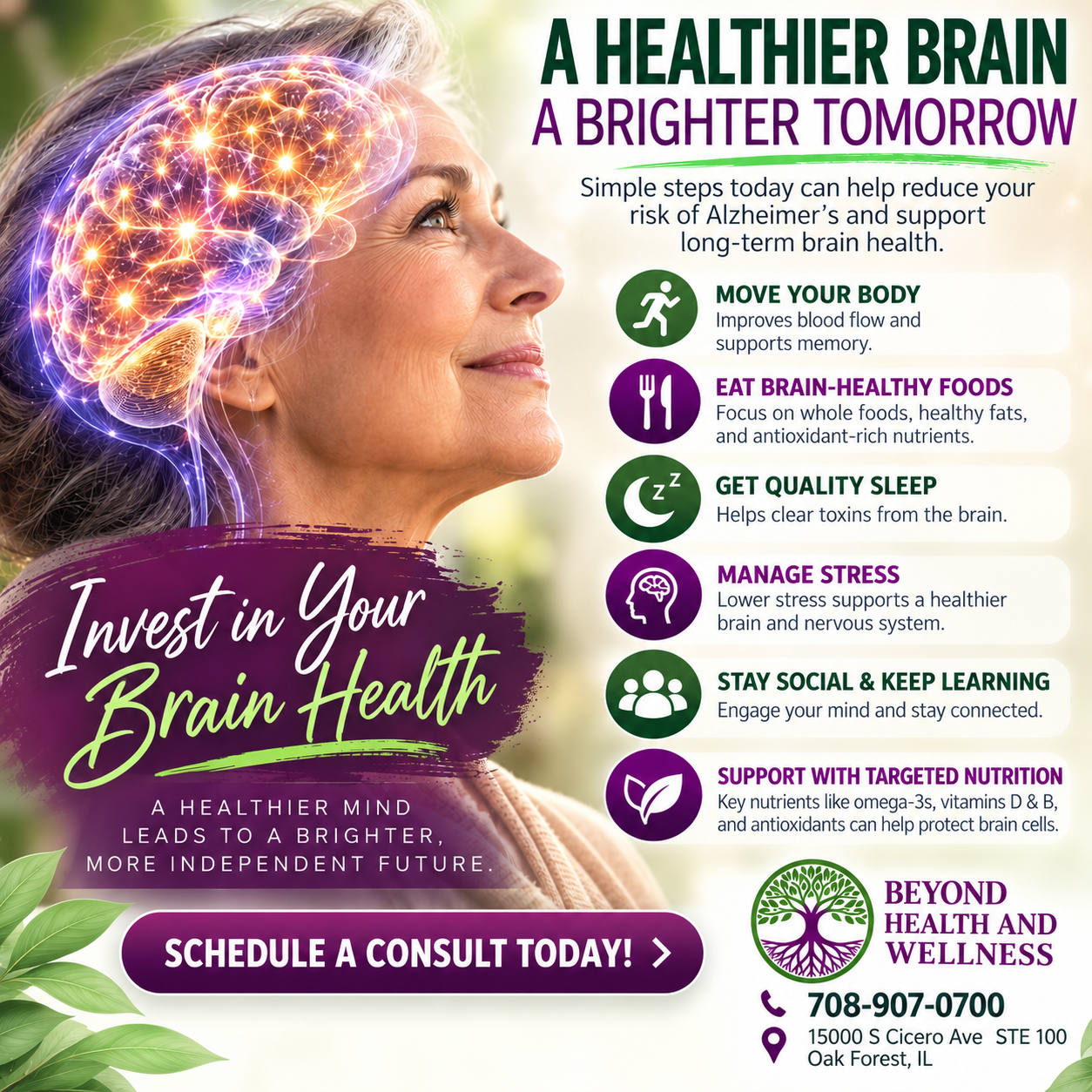
Sleep is paramount! Deep sleep is when your brain takes out the trash, including amyloid. If you're not sleeping, fix this first.
Move your body. In one well-known study, a year of brisk walking actually increased the size of the hippocampus, the brain's memory center, in older adults, reversing about one to two years of age-related shrinkage.
Manage stress and breathe. Chronic stress drives inflammation. Meditate, and learn how to truly breathe for your health.
Stay social and keep learning. The more stimulation your neurons get, the healthier they stay. Take that class, learn that instrument, call that friend.
Get your hearing and eyes checked. It sounds simple, and it's on the Lancet list for good reason.
FURTHER READING
Dr. Dale Bredesen published a small 2014 report suggesting that a personalized, multi-part program (diet, exercise, sleep, brain stimulation and targeted nutrients) improved memory in early-stage patients. It was a small study, but it changed how many of us think about this disease.
Curcumin (from turmeric) has shown anti-inflammatory and brain-protective effects in lab and animal studies. Human results have been limited so far, partly because it's hard to absorb. Promising, but not proven.
That sums up my take on the coming apocalypse. We need to take a proactive approach now, for ourselves and while our children are young. If you live in Oak Forest, Tinley Park, Orland Park, Midlothian or anywhere in the south suburbs and want to find out what's driving inflammation in your body, our functional medicine program starts with the testing. Learn about functional medicine or call (708) 907-0700.
Please talk with your provider before stopping or changing any treatment.
Yours in health and happiness, Dr. V.
Sources: Alzheimer's Association, 2026 Alzheimer's Disease Facts and Figures; Livingston et al., Lancet Commission on dementia prevention, 2024; Kumar, Moir, Tanzi et al., Science Translational Medicine, 2016; Weaver, Alzheimer's & Dementia, 2022; Chen et al., Nature, 2023; Wotton & Goldacre, Journal of Epidemiology and Community Health, 2017; Erickson et al., PNAS, 2011; Bredesen, Aging, 2014.
Beyond Health and Wellness, 15000 S Cicero Ave, Suite 100, Oak Forest, IL 60452
This article is for general education and isn't a substitute for a personal medical evaluation.