Look What I Made, Mom! What Your Poop Says About Your Health
By Dr. Ronald Vaught | Functional Medicine | Beyond Health and Wellness, Oak Forest, IL
Have you ever had your child so excited to show you something that they were bursting at the seams? Except when you went to see what they'd made, it was a perfect turd in the toilet! I'll bet you didn't actually study the masterpiece your child made. You flushed it as fast as you could.
In hindsight, what you should have done first, before you flushed, was note the size, shape, consistency, color and even the smell of your child's poo! Then you could have puffed out your chest and shown how proud you were of that smooth, brown, sausage-shaped, not-so-pungent Type 4 stool! Or you might have noticed a rank smell, very loose stool, hard little pellets, or even greasy, fatty stools. Those clues could lead you to dig a little deeper, maybe all the way to a diagnosis like celiac disease, and spare your child a lifelong struggle with symptoms no one can figure out.
STUDY YOUR STOOL FOR A BETTER GRADE IN LIFE
Like the child above, do you look at your poop in wonder, or do you flush without even looking? If you're not at least catching a glimpse, I suggest you start doing your homework. A little poo studying may help you make a better grade in life.
Your stool is about ¾ water and ¼ fiber, bacteria, cells and mucus, and you'll produce several tons of it in your lifetime. So let's roll up our sleeves and get busy... studying, that is!
Smell
The first thing you'll notice, before you even catch a view, is the smell of your creation. It won't be pleasant, but it shouldn't be offensive! If it smells foul even to you, it may point to a malabsorption problem or an inflammatory or autoimmune condition such as ulcerative colitis, Crohn's disease, celiac disease or a pancreas problem. And if you don't think you smell, but everyone else complains about the bathroom after you've been in it, maybe you need to pay attention.
Color
Next, turn around, open your eyes and behold! Healthy stool ranges from darker to lighter shades of brown. Bile is responsible for that color. Your liver makes bile to digest fat, stores it in the gallbladder, and as it moves through your gut it changes from yellow-green to brown. Here's what other colors may be telling you:
Green: More than likely a food change, like a kale binge, or the green beer you drank on St. Paddy's Day. If it sticks around, though, it may point to a gut microbiome wiped out by antibiotics or other medications, a bacterial or parasite infection, or a malabsorption problem.
Yellow: Foods can cause it briefly, but yellow that stays may signal fat malabsorption, or a gallbladder, liver or pancreas issue.
White or pale (clay-colored): This is never good. It means bile isn't reaching the stool, which may be caused by a blocked bile duct, or liver or pancreatic disease. See a doctor right away.
Black: Iron supplements, bismuth (Pepto-Bismol), blueberries or black licorice can all do it. If you can't blame one of those, treat it as possible bleeding in the upper GI tract, from an ulcer or something more serious, until proven otherwise, and get checked.
Red tinge: Beets and red food dye are common culprits. If it's not food, consider it bleeding from the lower GI tract, such as hemorrhoids, polyps, diverticular disease or tumors, and have it checked.
Shape and consistency
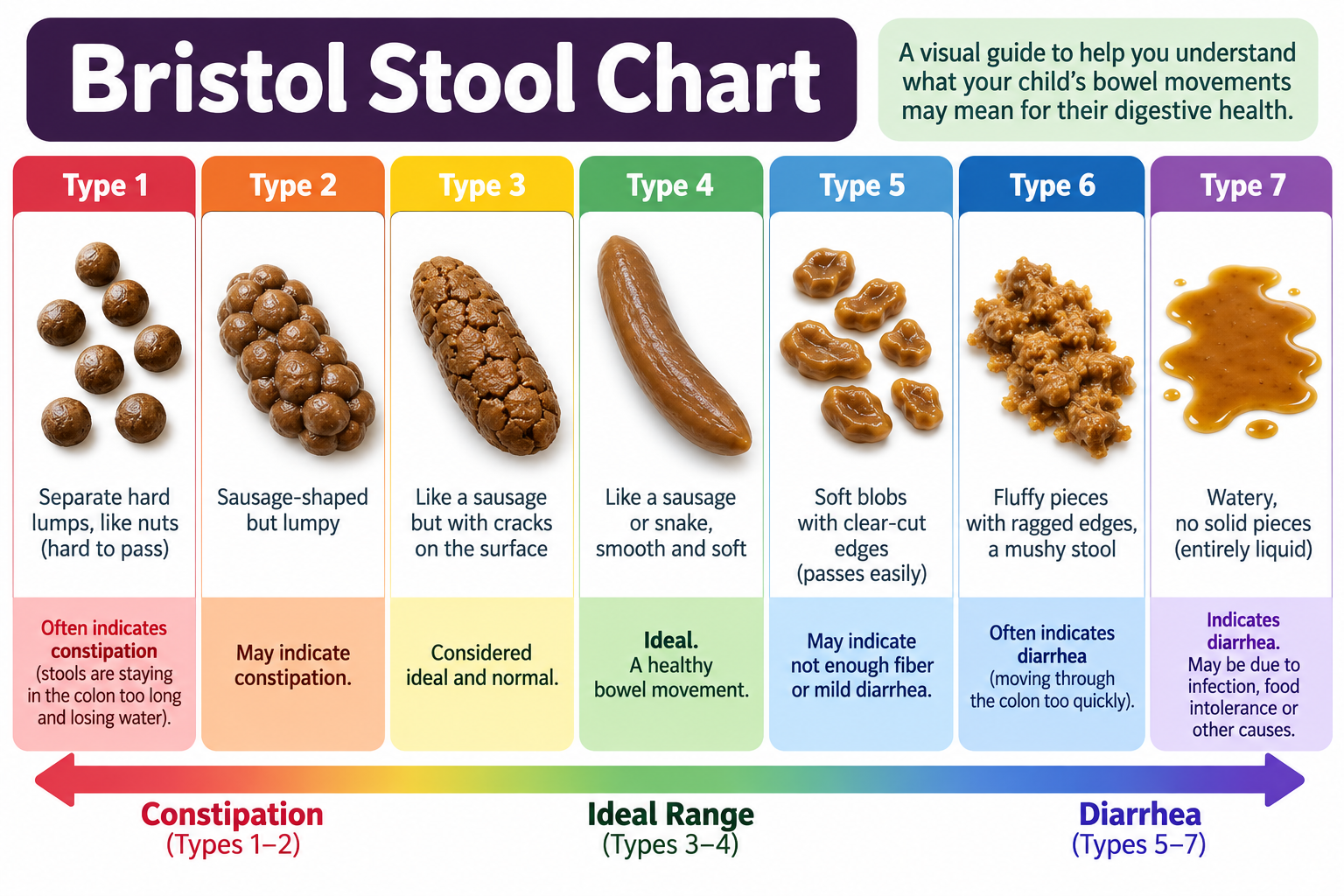
Now take in the shape and consistency of that masterpiece you just laid down! This is where the Bristol Stool Chart comes in (yes, there's an official medical chart to make talking about poop easier):
Type 1, separate hard lumps: Constipation. Often not enough fiber, fluid or good gut bacteria. Hypothyroidism, IBS, diabetes, neurological conditions, narcotic pain medications and antidepressants can all contribute.
Type 2, lumpy sausage: Also constipation. This stool may have been sitting in your colon for days, which makes it uncomfortable or even painful to pass.
Type 3, sausage with cracks: Normal, but a bit slow. You could use more fiber and water.
Type 4, smooth soft sausage: The gold standard! Effortless, painless and smooth.
Type 5, soft blobs: On the loose side. It can happen with more fluids or exercise, but may mean you need more fiber.
Type 6, mushy and ragged: Diarrhea. Seen with IBS, food sensitivities, autoimmune conditions, and bacterial or parasite imbalances.
Type 7, watery: You're unwell, often from a viral, bacterial or parasite infection. Pay attention fast, because losing fluids and electrolytes can become serious.
HOW TO RETURN YOUR POOP TO MASTERPIECE STATUS
OK, I'm embellishing a little here, I know. But let's at least make our studying pay off for our health!
Remove gluten: Gluten is very inflammatory to the gut, and none of us fully digests it. Wheat, barley and rye get all the attention, but every grain carries its own gluten-like proteins (called prolamins), like zein in corn, avenin in oats and orzenin in rice. Those can be just as problematic for sensitive people. That's why I have many of my patients remove all grains, not just wheat.
Eat whole foods: Eat as close to nature as you can. Organic when possible, grass- and pasture-fed meats, wild-caught fish. That keeps antibiotics and hormones off your plate.
No artificial sweeteners or processed sugars: They upset the balance of your gut microbiome and lead to dysbiosis.
Eat fermented foods: Sauerkraut, kimchi and other fermented foods are loaded with good bacteria that help repopulate your gut and help you digest your food.
Increase fiber: Vegetables, vegetables, vegetables! A little psyllium husk can also help sweep things along.
Stay well hydrated: Aim for about half your body weight in ounces of water. Your stool is 75% water... and so are you... drink up!
Exercise consistently: A body in movement creates movement within the body (yes, I'm talking about your bowel movement).
Take magnesium: Magnesium is vital for regular bowel movements, and most of us don't get nearly enough.
Question the medicine cabinet: Many common medications, from antibiotics to acid blockers to pain pills, can throw your gut off. Talk with your provider before stopping or changing any medication, but don't be afraid to ask whether a prescription is behind your bathroom troubles.
When your stool is telling you something
If what you're seeing in the toilet has been "off" for a while, whether it's constipation, diarrhea, foul smells or colors that don't make sense, that's your gut asking for help. In our functional medicine program, we go beyond guessing with testing such as comprehensive stool analysis and food sensitivity panels to find out what's really going on, then build a plan to heal your gut.
I hope our little cram session today helps you out in life. It's been a pleasure sharing it with all of you readers out there. Stay healthy, My Friends!
Call (708) 907-0700 or learn more about functional medicine at Beyond Health and Wellness.
Beyond Health and Wellness is located at 15000 S Cicero Ave, Suite 100, Oak Forest, IL, serving Tinley Park, Orland Park, Midlothian and the south suburbs.
This article is for general education and isn't a substitute for a personal medical evaluation. If you see black, red or pale stools, or have ongoing changes in your bowel habits, see your doctor promptly.